

How we keep water service lines free from lead
Test water pipes
Tacoma Water confirmed in 2024 that the water service lines (our water infrastructure) in our distribution system are non-lead. We took this action after the Environmental Protection Agency (EPA) required all utilities to know what kind of material makes up their water pipe system, whether the material includes lead, and to take an inventory process of their water service lines.
How did we find out our water line is lead free?
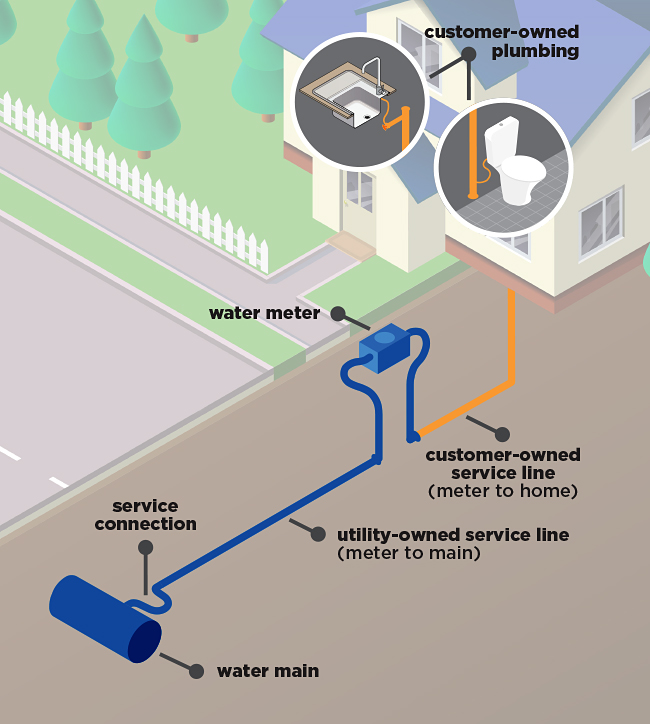
This diagram shows a breakdown of a typical water service line, labeling which pipes and sections belong to the property owner or the utility.
We used the following sources to determine our service lines don’t include lead:
- Service line installation records.
- Installation dates.
- Pipe sizes.
- Field inspections.
What is a water service line?
We own and maintain utility-owned service lines, shown below in blue. These pipes connect to the larger water main pipes, usually near the street, that bring water to your home or business. You own and maintain the property-side service lines and plumbing, shown in orange.
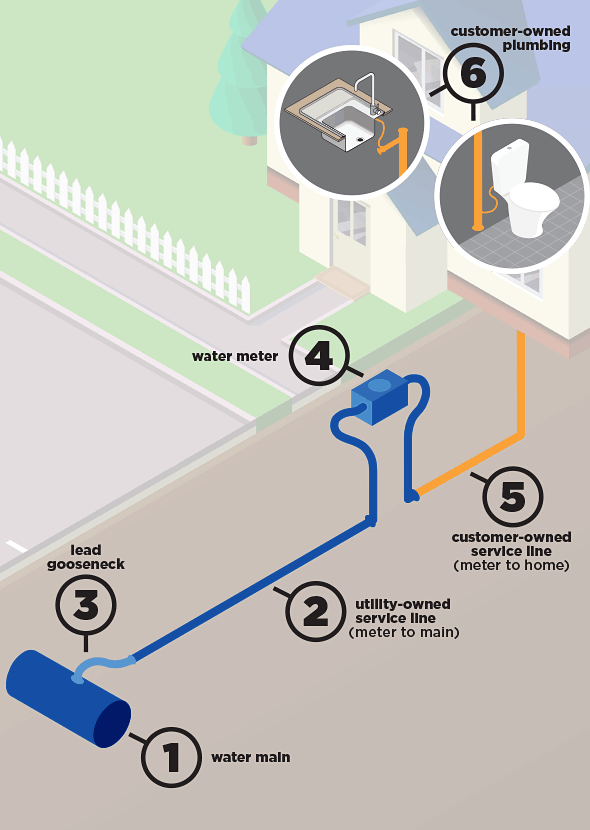
Replace lead “gooseneck” pipes
In 2016, we launched a five-year lead pipe replacement project and removed hundreds of lead pipes.
Between 1900 and 1940, these short pieces of lead pipe were sometimes used to connect the water main to customers’ service lines and were shaped like a goose’s neck, which is why they’re often called goosenecks.
Although we believe we had removed most of these lead goosenecks over the decades, we still knew of hundreds of old service connections that didn’t include original information. The 2016 project helped us find and remove the final 342 lead goosenecks.
Provide lead education and test kits
If you are a Tacoma Water customer, we can send you a free kit to test your water for lead. You can request your kit by filling out this form. After you receive your kit, collect a water sample at a tap in your home or business and send it back (no postage cost for you). We will then send it to a lab for testing and let you know the results. If any item is missing, please contact Tacoma Water at 253-502-8665 or waterquality@tacoma.gov to ask for another kit.
FAQs
-
To help prevent lead from getting into your water, we treat the water with a powerful chemical called caustic soda. Doing so raises the pH level (a measure of how acidic something is). Raising the pH makes the water less corrosive on plumbing, reducing the amount of lead that can dissolve into the drinking water. In addition to water getting treated with caustic soda at the Green River Watershed, we also treat our groundwater well supply with corrosion control treatment.
To clarify, lead in drinking water does not typically come from the water source. It usually comes from the plumbing that leads to or inside your home. Lead appears when plumbing, fixtures, or copper pipes connected to or containing lead get eaten away over time.
-
Environmental Protection Agency studies show that lead exposure can cause health problems, especially in pregnant women and young children. Children are at highest risk of lead exposure from soil, dust, and paint in older homes. While drinking water is not usually a significant source of lead, it can contribute to someone’s total exposure.
-
We include the results of our most recent round of lead sampling in our annual Water Quality Report that we publish online each year.
-
We consider homes built before 1986 with copper plumbing and lead solder, or homes that contain any lead piping, at the highest risk.
-
First, you can request a free water test kit. Second, we recommend you flush your pipes by running the water for several minutes until you notice the water temperature gets cooler. Cooler water is a good indicator that fresh water from the water main has made it to your faucet. It’s also a good idea to flush pipes after you haven’t used your pipes recently, such as when you return from a vacation.
-
We recommend you contact a plumbing professional to inspect your pipes if you are concerned about their condition. You can find more information on lead from the Environmental Protection Agency and the Washington State Department of Health.
-
We own the pipe from the water main to the water meter. So, when we replace a service water line, we do it up to the water meter. The pipe from the meter to the home belongs to the property owner.
This means the pipes on your side are usually the same age as the services that we replace, so they may not be in great condition. That’s why we recommend you hire a plumbing professional to inspect your pipe’s condition.
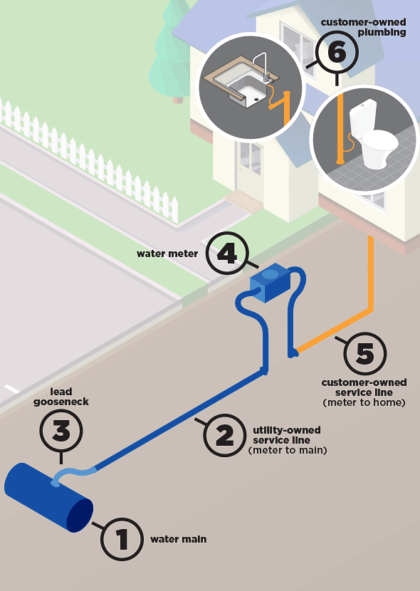
This diagram shows where the water line infrastructure from the street connects to a home.
Questions?
If you have questions or concerns about your water or about the status of the inspection of your service line, call 253-502-8207 or email WaterQuality@tacoma.gov.