

Solar and Net Metering FAQs
Have questions about solar or net metering? Find answers about choosing and installing a solar system, connecting to Tacoma Power, understanding your Net Meter Bank, and reading your electric bill.
Don’t see your question? Email Solar@tacoma.gov or call 253-502-8363.
A note about solar offers: Tacoma Power does not partner with or endorse solar installation companies and does not currently offer rebates or incentives for installing solar panels.
Understanding Solar and Net Metering
-
Net metering lets customers with solar or other eligible renewable energy systems connect to Tacoma Power’s electric grid and offset some of the electricity they use with the electricity they generate.
When your system produces less electricity than you need, you receive electricity from Tacoma Power. When it produces more than you use, the excess electricity goes to the grid and is credited to your Net Meter Bank.
-
Solar can reduce the amount of electricity you purchase from Tacoma Power, but your savings will depend on how much electricity your system produces and how much electricity you use.
Solar panels do not make your home more energy efficient. Before investing in solar, you may also want to consider energy-efficiency improvements that can help reduce your overall electricity use.
-
Yes. Your home or business will remain connected to Tacoma Power’s electric grid, so you will continue to receive a utility bill.
You are still responsible for fixed power charges and any other utility services on your account. You will also be charged for electricity you use that is not covered by your solar production or available banked kilowatt-hours.
-
If you produce more electricity than you use during a billing cycle, the excess kilowatt-hours are added to your Net Meter Bank. You can use those banked kilowatt-hours to offset electricity use during a future billing cycle.
-
Tacoma Power first applies available kilowatt-hours from your Net Meter Bank to eligible electricity-use charges. If your bank doesn’t cover all your electricity use, you are charged for the remaining amount.
Your Net Meter Bank
-
Your Net Meter Bank keeps track of excess kilowatt-hours your solar system sends to Tacoma Power’s electric grid.
When you generate more electricity than you use during a billing cycle, those excess kilowatt-hours are added to the bank. When you use more than you generate, available banked kilowatt-hours are applied to eligible electricity-use charges.
-
You can use banked kilowatt-hours toward eligible electricity consumption charges. They cannot be used toward fixed power charges or charges for other utility services such as drinking water, wastewater, surface water, or solid waste.
-
Your Net Meter Bank resets to zero each year on March 31, as required by Washington state law. RCW 80.60.030(5)
Any unused kilowatt-hours remaining in your bank expire at the reset. You immediately begin banking new excess kilowatt-hours after the reset.
-
No. The annual reset applies to net-metered customers under Washington State net-metering law. RCW 80.60.030(5)
-
We use available banked kilowatt-hours when calculating your final bill. If kilowatt-hours remain after we calculate your final bill, we remove them from the bank, and they are not eligible for additional compensation.
-
No. The Net Meter Bank and Washington State Renewable Energy System Incentive Program payments are separate. RESIP payments are based on annual solar production and are not calculated through your Tacoma Power utility bill.
Meter aggregation
-
Meter aggregation allows an eligible solar customer with more than one electric service meter at the same property to apply excess banked kilowatt-hours from a solar account to another eligible solar or non-solar account.
Meter aggregation is a billing function. The meters are not physically connected.
-
To qualify:
- The net meter and aggregated meter must serve the same or contiguous property.
- Both services must be in the same customer’s name.
- The account receiving the banked kilowatt-hours cannot also be a solar net-metered account.
For example, a customer may have solar installed on a detached garage with a separate electric account and another account serving the house. If the accounts meet the requirements, the customer may apply excess banked kilowatt-hours from the garage to the house account.
-
Submit Tacoma Power’s Meter Aggregation Request Form. Requests are reviewed based on Washington State net-metering requirements. RCW 80.60
Meter Aggregation Request Form
Before you install solar
-
Solar is a significant investment. Before choosing a system, consider:
- Your current electricity use.
- Your roof’s age and condition.
- How much sunlight your roof receives.
- Trees or other objects that may shade the panels.
- System maintenance and warranties.
- Any homeowner association requirements.
- The system cost and available financing.
Work with a licensed, bonded, and insured solar contractor, and consider getting several bids before deciding. Tacoma Power does not partner with or endorse individual solar installation companies.
-
The right system size depends on your electricity use, available space, and budget.
Your solar contractor can help you review your past electricity use and determine an appropriate system size. Because unused Net Meter Bank credits expire each March 31, customers should consider how much electricity they typically use when sizing a system.
-
Tacoma Power does not currently offer a rebate or other program to help cover the cost of installing solar panels.
Installing and connecting your system
-
Before installation begins, your contractor must obtain an electrical permit from Tacoma Power.
After obtaining the permit, your contractor must submit the Tacoma Power Solar Application and Interconnection Agreement, along with the required supporting documents.
Your system must meet Tacoma Power requirements and pass the required electrical inspection before it can be connected to the grid.
-
Yes. Solar customers need an Advanced Meter because it measures electricity received from Tacoma Power and electricity sent back to the grid.
If you aren’t already billed monthly, we’ll move you to a monthly billing cycle when your new solar system is interconnected.
-
Tacoma Power no longer requires a separate solar production meter for new installations. Customers can use their solar system’s monitoring equipment or app to track the electricity their system produces.
After your solar system is installed
-
Yes. Your home or business remains connected to Tacoma Power’s electric grid.
When your solar system isn’t producing enough electricity to meet your needs, you receive electricity from Tacoma Power
-
No. A standard solar system won’t power your home during an outage unless it includes a battery backup.
-
Check your solar monitoring equipment, app, or website to see whether your system is producing electricity as expected.
If you think there is a problem with your solar equipment, contact your solar installer for troubleshooting and information about equipment or labor warranties.
-
First, check your solar monitoring equipment, app, or website to make sure your system is producing electricity as expected.
If your system is not producing correctly, contact your solar installer. If your solar system appears to be working normally and you still have questions about your bill, contact Customer Service at 253-502-8600.
Understanding your solar bill and meter
-
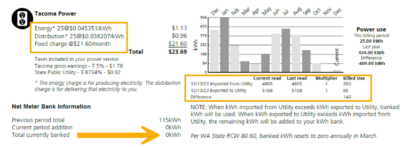
Imported from Utility is the electricity Tacoma Power delivered to your home or business.
Exported to Utility is excess electricity from your solar system that was sent to Tacoma Power’s electric grid.
Your bill compares these amounts to determine your net electricity use for the billing cycle.
-
If you export more electricity than you import during a billing cycle, the excess is added to your Net Meter Bank.
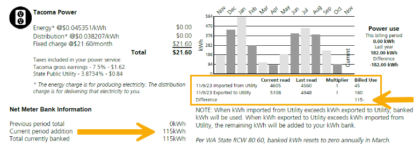
If you import more electricity than you export, your Net Meter Bank first offsets eligible electricity use. Your bill shows the amount added to or removed from your bank and your remaining balance.
-
You are responsible for:
- Electricity use that is not covered by solar generation or available banked kilowatt-hours.
- Fixed power charges.
- Charges for other utility services on your account.
Banked solar kilowatt-hours can only offset eligible electricity-use charges.
-
No. Budget Billing is not compatible with solar net metering. If you are enrolled in Budget Billing, it will end when your new solar system is interconnected.
-
Your Advanced Meter tracks electricity moving in both directions.
One reading shows electricity imported from Tacoma Power, and another shows electricity exported to Tacoma Power.
You may occasionally see 888888 on the meter display. This is a normal display check and does not indicate a meter problem.
State renewable energy incentives
-
Washington previously offered production incentives for qualifying renewable energy systems through the Renewable Energy Cost Recovery Incentive Program and later the Renewable Energy System Incentive Program, or RESIP.
Solar systems registered with the Washington State University Energy Program before the program closed may continue to receive incentives according to the terms of the program in which they were enrolled. The last payment for current participants will be given in 2027.
New solar systems are not eligible to enroll in these state production incentive programs.
Click here for more information on the Renewable Energy System Incentive Program.